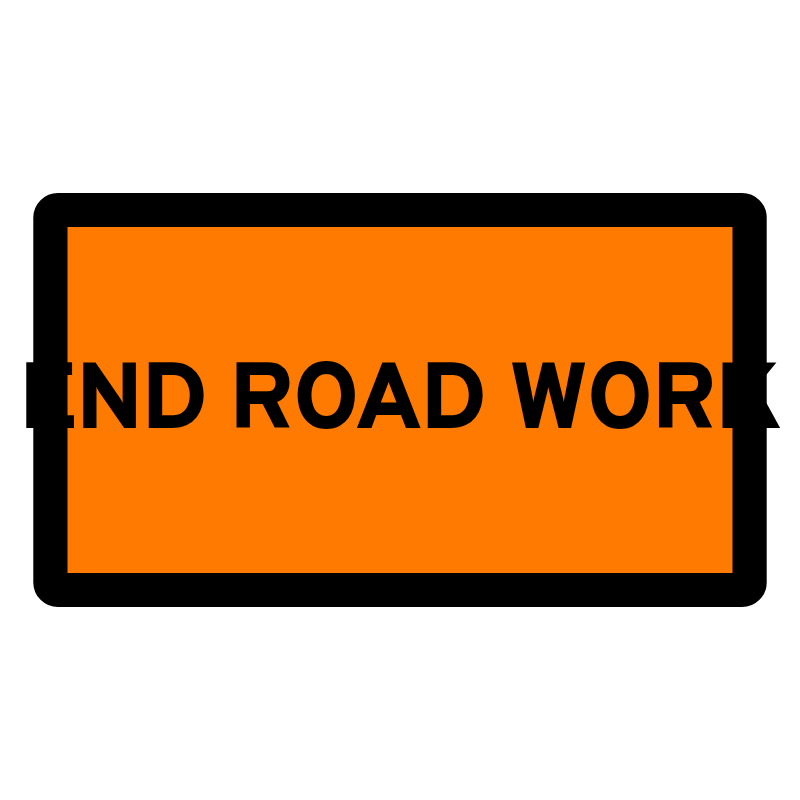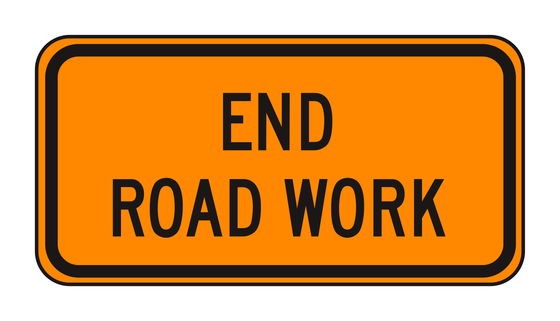
Marks the downstream end of a work zone, informing drivers that they have passed the work area and that normal conditions resume.
MUTCD-style sign reference illustration. Always verify against the official CA MUTCD and Caltrans sign charts.
| Sign code | G20-2 |
|---|---|
| Federal code | G20-2 |
| Name | End Road Work |
| Category | Guide Signs |
| Shape | Rectangle (Horizontal) |
| Color | Orange background, black legend |
| California status | Used in California per CA MUTCD |
| Typical CA minimum size | 48" × 24" |
The official dimensioned layout drawings below show the exact border widths, legend and letter heights, spacing, corner radius, and the standard sizes used to fabricate G20-2. Use them to confirm sign sizing for your road type before finalizing a traffic control plan.
| Application | Size |
|---|---|
| Standard (TTC) | 48" × 24" |
Source: CA MUTCD Part 6F (Temporary Traffic Control). Confirm the exact size for your road type and speed against the current CA MUTCD and the official layout drawing.
Layout drawing extracted from the FHWA Standard Highway Signs (public domain). Verify exact dimensions and sizes against the current CA MUTCD, Caltrans sign specifications, and Standard Plans for your application.
Download this sign or open the official MUTCD reference.
Official source: FHWA Standard Highway Signs, 2024 (11th Edition) — Guide signs.
This is an educational reference. Verify sign use, size, placement, and application against the current CA MUTCD, Caltrans sign specifications, Standard Plans, and the reviewing agency. Official source links are gathered in one place.
View official sourcesMarks the downstream end of a work zone, informing drivers that they have passed the work area and that normal conditions resume.
Marks the downstream end of a work zone, informing drivers that they have passed the work area and that normal conditions resume. In the field, G20-2 End Road Work is typically positioned at the termination (downstream) area. Common deployments include termination area at the end of a work zone; closes setups that began with ROAD WORK AHEAD; used on both short and long-duration operations. Always confirm its size, retroreflective sheeting, spacing, and placement against the CA MUTCD 2026 and the reviewing agency before finalizing the traffic control plan.
Placed at the end of a California TTC zone past the last work activity and termination area, closing out the sign sequence.
Common field deployments
Agency review note
StreetsLA, LA County DPW, and Caltrans District 7 may require larger sizes or additional devices. Verify with the reviewing agency before finalizing the TCP.
Typical minimum: 48" × 24".
Sizes are CA MUTCD minimums and vary by roadway classification and speed. Verify against the CA MUTCD 2026 (CA MUTCD Part 6, Chapter 6F (Temporary Traffic Control)), Caltrans sign specifications, and the reviewing agency.
Where it sits: Termination (downstream) area.
CA MUTCD reference: CA MUTCD Part 6, Chapter 6F (Temporary Traffic Control).
In Los Angeles, this sign must conform to CA MUTCD 2026. Work in City of LA right-of-way is reviewed by StreetsLA and the Bureau of Engineering (BOE); state highways in LA County are permitted and reviewed by Caltrans District 7; county roads are permitted by LA County DPW. Sizes, retroreflectivity, and placement must meet CA MUTCD minimums — local agencies may require larger signs based on roadway class, speed, pedestrian volume, and proximity to schools or transit.
Confirm END ROAD WORK is positioned past the termination area so drivers know the zone has ended. Public Ready reviews termination-area signing.
These signs are typically deployed alongside G20-2 on a California TCP.
Need END ROAD WORK (G20-2) to close out a work zone? Public Ready can supply it with the full sign sequence.
Free official resource — opens official government website
Educational reference only. This is not an official Caltrans, FHWA, or local agency publication and is not legal or engineering advice. Always verify sign selection, size, placement, spacing, and application against the current CA MUTCD 2026, Caltrans sign specifications, Standard Plans, project documents, and the reviewing agency’s requirements.
This sign is commonly used in detours and traffic rerouting. Learn more about lane closure and detour requirements, setup, and field readiness at WorkZoneCompliance.com.
Learn more at WorkZoneCompliance.comPublic Ready can help with G20-2 End Road Work — including sign rental or purchase, work-zone signs, TCP sign legends, and permit coordination, and agency-review support for Caltrans District 7, the City of Los Angeles, and LA County.