
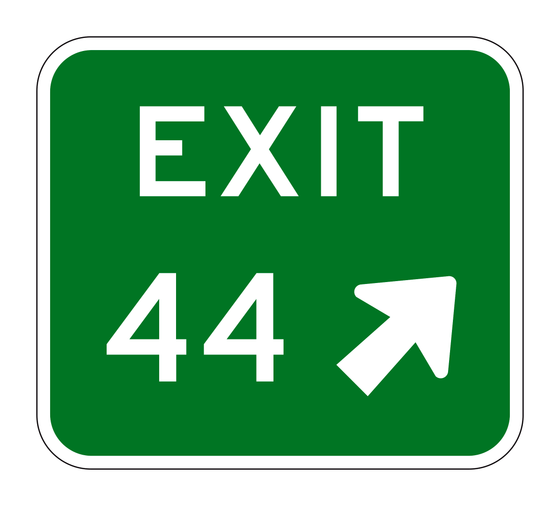
EXIT GORE SIGN Sign Requirements
This guide summarizes the MUTCD requirements and practical application guidance for the G84-2(CA) EXIT GORE SIGN sign. Use this resource to understand when it is required, how to place it correctly, and how to maintain clear visibility for safe operations.
When It Is Used
Applied per the CA MUTCD and Caltrans sign specifications
Where It Applies
At the decision point, junction, or service location the sign serves, per CA MUTCD Part 2 and Caltrans placement standards.
Placement Basics
Mount at the standard height and setback for the roadway with clear sight lines.
Visibility / Reflectivity
High reflectivity and clear sight lines are essential day and night.
1. When a EXIT GORE SIGN Sign Is Used
The G84-2(CA) Exit Gore Sign is a California MUTCD sign. Official depiction: Caltrans CA Sign Chart, 2014 Revision 3 (Sheet 10). Official title per CA MUTCD Table 2D-101(CA): “EXIT (XX) with Arrow” (Section 2E.28). No standalone Caltrans specification drawing is published for this sign.
- Applied per the CA MUTCD and Caltrans sign specifications
- Selected and sized for the roadway type and setting
- Coordinated with the overall signing plan and permit
2. How and Where It Applies
In the field, G84-2(CA) Exit Gore Sign is typically positioned at the advance warning area, ahead of the work. Common deployments include applied per the CA MUTCD and Caltrans sign specifications; selected and sized for the roadway type and setting; coordinated with the overall signing plan and permit. Always confirm its size, retroreflective sheeting, spacing, and placement against the CA MUTCD 2026 and the reviewing agency before finalizing the traffic control plan.
3. Placement and Application Notes
Position G84-2(CA) at the decision point, junction, or service location the sign serves, per CA MUTCD Part 2 and Caltrans placement standards.
- Place the sign where drivers have a clear, unobstructed view on approach.
- Mount at the standard height and setback from the edge of the traveled way.
- Do not mount with other signs on the same post unless space constraints require it.
4. Standard Sizes and Visibility Considerations
Typical minimum: Size varies with legend length and roadway class; set letter height, spacing, and border per the Caltrans Sign Specifications.
- Choose size based on roadway speed, sight distance, and mounting location.
- Maintain high retroreflectivity for maximum night and adverse-weather visibility.
5. California Notes
Used in California per the CA MUTCD; its official depiction is on the Caltrans CA Sign Chart (2014 Rev 3, Sheet 10). Confirm size, retroreflective sheeting, and placement for the condition and the reviewing agency. No standalone Caltrans specification drawing is published for this sign, so dimensions are not asserted here.
Go to California Notes6. Common Field or Planning Mistakes
- Official depiction: Caltrans CA Sign Chart 2014 Rev 3, Sheet 10 (no standalone Caltrans specification drawing).
- Verify size for the roadway classification and setting.
- Confirm retroreflective sheeting class per the CA MUTCD.
- Verify placement and mounting height per the CA MUTCD.
Related Resources
View All G-Series Signs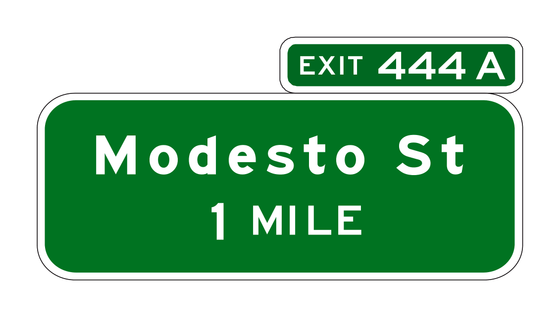
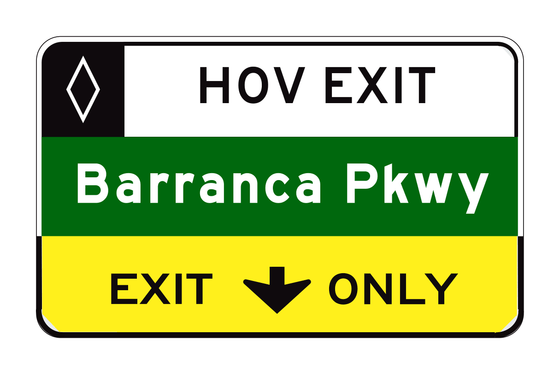
Educational reference only. This is not an official Caltrans, FHWA, or local agency publication and is not legal or engineering advice. Always verify sign selection, size, placement, spacing, and application against the current CA MUTCD 2026, Caltrans sign specifications, Standard Plans, project documents, and the reviewing agency’s requirements. Local jurisdictions may impose additional requirements, and final selection, placement, and dimensions may require engineering judgment or agency approval. Written against California MUTCD 2026 (effective January 18, 2026) and the Federal MUTCD 11th Edition. Official sources last verified June 2026.
Need to Rent or Purchase This Sign? Contact Public Ready.
Public Ready supports sign selection, project-ready sign packages, and equipment sourcing through qualified providers — with expert support built for compliance.