
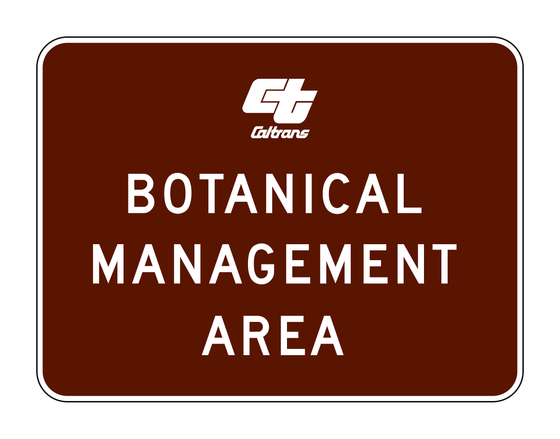
G200-82A(CA) BOTANICAL MANAGEMENT AREA Requirements
Application notes for G200-82A(CA) BOTANICAL MANAGEMENT AREA. The official manual distinguishes mandatory standards, recommended guidance, and optional applications; consult the linked sources for the provisions that apply.
1. When BOTANICAL MANAGEMENT AREA Is Used
Identifies a botanical management area. The message distinguishes the managed area from a general roadside destination.
2. Placement and Application Notes
Position G200-82A(CA) at the location appropriate to this guide-sign function; consult the linked manual and drawing for its application.
- Place the sign where the intended road users have a clear, unobstructed view on approach.
- Use the mounting height and lateral placement specified for the sign and installation type.
- Use sign assemblies and supplemental plaques only as provided in the applicable manual and approved design.
3. Layout Sizes and Visibility Considerations
Linked-layout dimensions: 18" × 12"; 24" × 18"; 30" × 24". Check the applicable MUTCD and agency requirements for the required installation size.
- Choose size based on roadway speed, sight distance, and mounting location.
- Use the visibility and material requirements specified for this sign and installation.
4. Sign Selection Checks
- Match G200-82A(CA) and its displayed legend to the intended condition.
- Check the source drawing for the required directional or message variant.
Related Resources
Browse All Sign Series

Verify G200-82A(CA) Requirements
This is an educational reference. Verify sign use, size, placement, and application against the current CA MUTCD, Caltrans sign specifications, Standard Plans, and the reviewing agency. Official source links are gathered in one place.
View official sourcesEducational reference only. This is not an official Caltrans, FHWA, or local agency publication and is not legal or engineering advice. Always verify sign selection, size, placement, spacing, and application against the current CA MUTCD 2026, Caltrans sign specifications, Standard Plans, project documents, and the reviewing agency’s requirements. Local jurisdictions may impose additional requirements, and final selection, placement, and dimensions may require engineering judgment or agency approval. Reference editions: California MUTCD 2026 (effective January 18, 2026) and the Federal MUTCD 11th Edition with Revision 1.
Need to Rent or Purchase This Sign? Contact Public Ready.
Public Ready supports sign selection, project-ready sign packages, and equipment sourcing through qualified providers — with expert support built for compliance.